THE LUCKY ONES MAY NOT HAVE REALIZED
they were dying. The casino was on fire, they might have
known that. But no flames were drawing near, thick smoke
wasn't pouring in through the vents or under the doors,
as was happening elsewhere in the MGM Grand hotel-casino
that Friday morning, November 21, 1980. Also, it was just
after 7 a.m.; they might have been asleep, still groggy.
They may have retained a semblance of calm, awaiting rescue.
But they were doomed anyway, doomed by the very thing that
made mass tourism possible in Las Vegas: air-conditioning.
It filtered out the smoke but pumped deadly carbon monoxide,
a silent killer, into their rooms.
The unlucky ones knew. Trapped in smoke-choked stairwells,
the doors automatically locked behind them in an ironic
fire-safety measure, they clawed their fingers bloody on
any millimeter of purchase that might pry open a way out;
news accounts mention the red handprints they left on the
walls. Others stumbled through corridors, lungs filling
with toxic smoke. At what moment did each of the victims
understand they were going to die--that whatever wealth
they'd amassed couldn't save them, nor their devout faith,
nor their worldly accomplishments? Imagining those awful
moments of realization can break your heart 20 years later.
 |
|
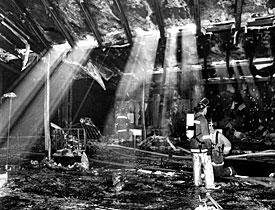
Weary, some barely dressed, they were staggered by the event's
enormity.
The truly lucky ones, of course, were those who got out
alive, many injured--some badly--but gratefully alive. Some
jumped or slid down ropes. Some fled to the roof and were
choppered to the ground. Some were rescued by ladder. Some
bashed open their windows for the fresh air, raining glass
shards, televisions and hotel furniture to the ground. Some
remained safe in their rooms. Some crossed that threshold
of realization, knew absolutely that they were about to
die, but--lucky, lucky--did not.
The enormity of it--the freakish extremity of it. That's
what strikes you in hindsight, how outsize everything about
the MGM fire was: the monster fireball, and the heedless
ferocity of its consumption; the dramatic tower of smoke,
said to be 2,000 feet high; the vast emotional panorama
experienced by the victims, survivors, rescuers, onlookers;
the sprawling, precedent-setting legal actions that followed;
and the death toll itself, 87, making it the second-worst
hotel fire in the nation's history.
Then again, maybe it's the small things that stand out.
The way a seemingly innocuous decision--to stay in the room
with one group of friends or go downstairs with another--would
have life-or-death implications for Perry Beshoar of Western
Springs, Illinois. Or the way a hundred twists of fate delivered
an MGM maintenance man into a 10th-floor corridor just in
time to stop Robert and Linda Boogren of Westland, Michigan,
from going into a stairwell ("Don't go down those stairs!
Those doors will lock behind you!"). Or the way Roger
Mack of Beaumont, Texas, wracked by the agony of two broken
legs after sliding down a construction rope, managed to
lift his head and croak, "How is my wife?," meaning
Delores, who'd gone first. (The answer would shatter his
heart, too.) Or the soot trails leading up the nostrils
of the dead. Or the way human memory balks and falters over
some details of the event, yet randomly inscribes others
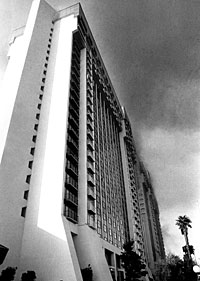
so indelibly. Or the way so much devastation--a 26-story
box of sheer human misery--can flare from an epicenter as
small as a wire.
TOM HUME WASN'T WORRIED. HELL, PEOPLE PROBably scream in
hotel hallways all the time in Vegas--it's Vegas. Particularly
in one of the city's flagship hotels (today, it's Bally's).
Those noisy bastards undoubtedly won a bunch or lost a lot
or drank too much. "Don't pay attention to those people,"
the Cincinnati Reds pitcher told his wife as they drowsed
in bed. "This is Las Vegas. There's nothing to be alarmed
about." He and his teammate, Bill Bonham, and their
wives had stopped in town on their way to Tucson to play
in a March of Dimes celebrity golf tournament; they were
on the 24th floor, two from the top.
"Then I went over to the window and saw smoke coming
up the side of the building," he says by phone from
an Indiana fishing trip.
It had started downstairs, in an attic above a kitchen
that served several restaurants. Faulty wiring. It smoldered
for a few hours, unsuspected by employees or guests, flaring
up just after 7 a.m., quickly bursting into violent life,
unchecked by sprinklers (the casino had none), propelled
by its own fury, racing into the casino, killing people,
scorching slot machines, singeing lives.
It didn't seem that big when the firemen of Station 11,
then located across Flamingo Road, arrived shortly after
the 7:19 call. No smoke or signs of fire outside. Routine
grease fire, probably.
Tourist Kurt Schlueter, a firefighter with the Western
Springs, Illinois, fire department, had just ordered coffee
in the coffee shop downstairs with a co-worker, Dave Beshoar,
and Beshoar's brother, Perry. Their friends David Potter
and William Gerbosi, also firemen, were still upstairs getting
dressed. Perry almost stayed in the room, opting at the
last minute to come downstairs. "A security guard came
up to us and said, 'We have to evacuate the restaurant,
there's a small fire next door,'" Schlueter says by
phone from Illinois. "We looked around the corner and
we could see the fire and it didn't look that big."
He and Beshoar offered their firefighting services, but
the guard said the equipment was inaccessible. Instead,
they helped herd other patrons out.
Some gamblers weren't ready to leave on account of a stupid
kitchen fire. One blackjack dealer told reporters, "I
was dealing to two middle-aged ladies and noticed the smoke
first. The ladies wanted to keep playing, but I said, 'No
way.' They were kind of upset when I told them they had
to leave." Entering the casino, the firemen from Station
11 still thought it was nothing out of the ordinary. Then,
with a terrible swiftness the firefighters would later compare
to high-speed photography, a ball of fire raged from The
Deli restaurant, whooshing along the combustible casino
ceiling, consuming everything in its way. Someone said,
"Get the drop boxes!" A dealer shouted back, "Screw
the boxes, get yourself out of here!" In the kitchen,
two cooks ducked into a freezer. The smoke and heat pushed
Schlueter and his friends out the door. Standing outside,
watching the flames lick out of the building as the firemen
dragged their hoses into position, the three wondered what
had become of Potter and Gerbosi.
The casino area was in flames, and because the MGM was
built in 1973--"the golden era of plastics," one
lawyer would later say--deadly fumes quickly rose through
the ventilation systems and stairwells.
Up on the 24th floor, Tom Hume pulled on his pants and
stepped into the hallway. Smoke everywhere. He banged on
Bonham's door, then pounded warnings on other doors before
hurrying to his room to get dressed. He yanked on his boots--no
socks, he remembers--while his wife got into her warmup
suit and they headed down the stairwell. He remained calm,
he says.
"Billy and his wife were in front of us, and Billy
was helping these ladies carry their suitcases down the
stairs, and I was like, 'Billy, let's go!'" About 10
floors down, the smoke got to be too much and they decided
to head for the roof.
On the 16th floor, Marv and Carol Schatzman were getting
ready to return to St. Louis that morning; they had an 8:15
flight. Marv was heading down to check out. He paid no mind
to the haze in the hallway, didn't even think about it.
A bellboy ran up to him and asked in broken English to use
the phone in the Schatzman's room. But the phone wasn't
working and the bellboy blurted, "I think the hotel
is on fire." They looked out the window saw the fire
engines. They'd heard no alarm.
Again, the fortuitous twist of fate: Had Marv gotten on
the elevator, it would have delivered him to the fire. Now,
instead, they headed for the stairwell. Along the way, Carol
pounded on doors, shouting "Smoke! Smoke!" instead
of "Fire!" because she'd heard that if you shouted
"Fire" and it turned out there wasn't one, you
could go to jail.
Civilian, police and military choppers joined the lengthy
rescue operation.
WHEN WE GOT OFF the freeway we could see flames coming out
of the front lobby," recalls Metro Officer Tim Montoya,
who arrived about 20 minutes after the alert. "It was
just enormous." He was assigned to the perimeter, trying
to keep the growing crowd of gawkers at bay. High above,
MGM guests leaned from their windows, screaming. "I
felt a sense of helplessness," he says. "You feared
for their lives because there was no way to get them out.
Most people in a fire die from the smoke, and it was obvious
the smoke was traveling straight up the stairwells. You
felt that the people you were looking at were not going
to be alive much longer. The smoke was coming out of their
rooms behind them."
Patrolman Tom Thowsen of the canine unit was there with
his dog, Izzy, also on the perimeter. While the fire was
still burning, word came down that there might be looters
inside, scooping up chips and money. Thowsen was among those
ordered to check it out. "We start up the steps going
into this place, and there was a firefighter there with
an air pack on. He said, 'What're you doing?' We said, 'We've
been told there are looters in there.' And he said, 'It's
full of toxic fumes and smoke! You won't be able to breathe!'
And we realized there was probably no one in there looting."
Mel Larson, then a vice president of Circus Circus and
an accomplished helicopter pilot (he and his wife owned
Action Helicopter Services), had seen the smoke from his
home and scrambled his pilots to help. "People were
hanging out of windows, motioning for us to come get them,"
Larson says. No way he could swing the chopper that close,
of course, so he had to look at their panicked faces and
know there was nothing he could do for them. Instead, he
headed for the roof, to help survivors gathered there.
Some people jumped; Kurt Schlueter would never forget that
sight. One witness told the Las Vegas Sun that he'd seen
a heavyset man shimmying down a rope of knotted sheets before
plummeting three stories. Moments later, a woman tried the
same rope, falling too. Inside, many guests simply waited
in their rooms, some lying on the floor with wet towels
over their heads, others smashing their windows or opening
the balcony doors. A woman in one room called Las Vegas
Sun reporter Mary Manning, looking for details on the fire;
she was so nervous, she confessed to Manning, that she'd
lit a cigarette. Roger and Delores Mack found a construction
rope knotted to a balcony on the ninth floor. In a decisive
moment, Delores, perhaps thinking it her only chance, went
first; she'd slid just a few feet before she fell, landing
on a second-story roof, crushing her head. Roger slid after
her, breaking both legs.
DOWN WASN'T RIGHT. Down was, in fact, very, very wrong.
So Tom Hume's party headed up the stairwell through the
choking fumes, a dispiriting prospect. "I remember
my wife sitting down," Hume says, "sitting on
the stairs, and she said, 'I can't go any further.' And
I took her warmup top and stuck it over her face and I said,
'You go until I say stop! And you don't stop until I tell
you to!' And she said, 'Yeah, but there's nobody there.
There's nowhere to go.' And I said, 'Let's go!'"
The Schatzmans, descending their stairwell from the 16th
floor, ran into a crush of people around the ninth, some
barely roused from bed and still half-dressed. "More
people kept getting in and there was no air and you couldn't
hardly see and you could hardly breathe," Marv says
from the couple's St. Louis-area home. "They said the
fire was down here and we had to go back up."
Up was hardly better. The smoke was blinding now, strangling.
People were succumbing to it, flopping onto the stairs or
sitting there, wheezing to catch a breath or just giving
up. Others, some breathing heavily through wet towels, continued
upward. The Schatzmans, nearly overcome, were reduced to
crawling blindly through the fumes. "When you inhale
smoke it makes your extremities very weak," Carol says.
"A lot of people were sitting down because they had
given up and we had to crawl over them."
There was no screaming, Carol wrote in an account of their
adventures she typed up when they returned to St. Louis.
No one could breathe enough to scream. There was no panic.
About the 24th floor, I knew we were going to die. She had
arrived at that terrible moment of realization, the sure,
sudden awareness that she was going to die a grim suffocating
death in a damn stairwell in Las Vegas. Still, they retained
their humanity. Marv took a woman's hand, tried to pull
her upward. "And in all the ... I guess ... the action,"
he recalls, his voice faltering, "I lost the hand.
And I know she didn't get out." Along with those strong
enough to continue on, the Schatzmans kept crawling toward
the roof, hoisting themselves along on the handrail, unsure
what would await them up top, if they ever got there. Locked
door? Unlocked?
A wet towel helped ward off the fumes from burning plastic.
FIREFIGHTERS MOVED up the stairwells, fanning out to look
for survivors. Engineer Bill Trelease was part of the rescue
effort, busting down doors and performing CPR--when it wasn't
too late. "One gal, she'd been by the elevator, pushing
the button," he recalls. "She died there, and
you could see her fingerprints going down the soot on the
wall; her arm was still outstretched when we found her."
In a stairwell, he came across several bodies piled on top
of each other, as if stacked that way. Breaking through
one door, he found an elderly couple, kneeling in prayer
at the foot of their bed. Dead. At wrenching moments like
that, a firefighter's mind constricts around a narrow cluster
of priorities that amount to this: save the living.
GROPING UPWARD, THE SCHATZMANS EXPECTED TO encounter parties
of people coming back down, telling them the door was locked.
Carol knew she couldn't maintain hope in the face of that.
Memory is mystifying, erratic, particularly when it's forged
in the literal crucible of a tragedy like the MGM fire.
Was the young man who leaned over the top of the stairwell,
shouting that the rooftop door was open, a shirtless 20-year-old,
as Carol noted in her written account, or a 16-year-old
in his underpants, as she remembers now? All that matters
is that he had the guts to duck back into the smoke-filled
stairway and let the others know that safety awaited. Then
we saw the sky through the open door, Carol wrote. My God,
it was heaven!
SOME NEWS ACCOUNTS FROM THE TIME DESCRIBE A full-tilt,
fall-of-Saigon panic on the roof, with men pulling women
out of rescue craft to secure themselves a seat, and a crowd
surging against a helicopter, shoving it perilously close
to the edge. Those up there say it wasn't quite that bad,
although firefighter Bill Trelease remembers it as akin
to "an LZ in Vietnam." Soot-stained and gasping,
the survivors were frantic, "trying to hang on the
skids, or stand on the skids" of the several choppers,
Mel Larson says, and others say people were clutching up
at the aircraft before they could land, sometimes impeding
the pilots or coming dangerously close to the tail rotors.
But for the most part, order prevailed, despite some folks'
fear that the roof could collapse at any moment into what
they imagined must be a roaring inferno below.
This being an earlier era of technology, the roof didn't
bristle with satellite dishes, aside from a few antennae
that had to be broken off to make way for the choppers.
Extra helicopters--commercial, official, construction--arrived
to help ferry down the evacuees. Military pilots engaged
in Red Flag exercises at Nellis were dispatched to assist.
All those rotors helped dispel smoke on the roof, although
the jumbo military choppers had an unforeseen side effect:
They pushed smoke back into the building, where firefighters
were assisting people. "You'd hear them coming and
you knew you were screwed," Trelease says. "Within
30 seconds the smoke would again be so thick you couldn't
see your hand in front of your face." Guests whom the
firemen had managed to settle down would freak again.
Safely on the roof, Tom Hume somehow managed to dump out
a pocketful of change. With the eerie calm that sometimes
descends on participants in a disaster, he bent down and
carefully picked it all up. His wife was rattled, but he
knew, he just knew, that they'd survive.
We formed lines to wait for the helicopters, Carol Schatzman
wrote. I began to think we might have a chance. Women went
first. A black man put his wife in a helicopter and turned
away. A man was in line behind him trying to get on, and
he said, "Man, we want the women to be safe, don't
we?" and the man said, "Yes, forgive me."
It made me cry even more.
The Schatzmans watched one man escort his wife safely to
the roof, then dash back into the stairwell to find her
sister, who had been right behind them. Neither came, Carol
wrote.
Hume and Bonham put their wives on the choppers, then waited
their turn. Hume estimates that they were among the last
men off the roof, but here his memory blanks: "I don't
remember getting on the helicopter and flying to the ground,"
he says. "I know we landed in a parking lot."
The Schatzmans were separated when Carol was choppered
down with three women in nightgowns, their bare feet bleeding.
Carol was a mess. "Our faces were black," she
says. "I have blond hair and it was green."
Forty minutes after Carol came down, Marv followed, seemingly
in bad shape. The medical personnel thought he'd had a heart
attack; his lips were blue from inhaling the soot. He was
taken by ambulance to Desert Springs Hospital for a battery
of tests. Carol sat in the waiting room with a Mexican woman
who didn't speak English. Bonded by tragedy, they said the
Rosary and comforted each other. Someone asked Carol if
she wanted a drink and was taken aback when she answered,
"Brandy." I meant coffee or orange juice! the
woman replied. "The doctor turned around and said,
'Oh, hell, I've got some Scotch in my desk,' so he went
and got it. No one drank it, we just sat and looked at it,
but it made us feel good to know it was there."
Survivors wound up all over the place. Some went to the
Barbary Coast, where shift manager Steve Morrill closed
the tables for three hours and converted the lounge into
a makeshift medical area. ("When I walked in the door,"
Barbary Coast owner Michael Gaughan recalls, "Steve
came running toward me, panicked, worried about whether
or not he did the right thing. Of course, I told him he
did.") The Rev. Billy Graham, in town for four days
of evangelism, "walked among the dazed and crying tourists
at the still burning hotel, helping comfort them,"
according to one newspaper. Like most evacuees, Kurt Schlueter
and his companions wound up at the Convention Center, amid
the dazed, haphazardly dressed multitude (one woman was
in a nightgown and mink stole, all she managed to throw
on before escaping). "We spent the rest of the day
looking for our two buddies," he says, his voice breaking,
two decades later. A friend from another hotel picked them
up and, with fading hope, they checked out hospitals, the
morgue. "Nobody could give us a straight answer about
where they were," Schlueter says. "There were
so many conflicting stories."
Until: "We finally found them in a portable morgue."
The fire burst from the kitchen in a huge cinematic fireball.
LAS VEGANS RALLIED QUICKLY. RESIDENTS BROUGHT clothing and
blankets to cover the survivors. Carol Schatzman remembers
several stores letting people charge clothing with only
a name and address. Some who came to gawk found themselves
pitching in. Hotels offered free or cut-rate rooms, sent
food and supplies to the staging areas; the Landmark reportedly
had security guards running to nearby pharmacies to fetch
medications for the survivors. The Rev. Billy Graham declared
that he'd never seen a community pull together like this.
Not everyone behaved as Graham would have wanted, however.
Several people were arrested for interfering with rescue
units, and, according to news reports, before the fire was
even out, an MGM security guard was busted at a nearby casino
for gambling with wet, burnt bills he presumably scooped
from tables as he escaped.
Released from the hospital, the Schatzmans were shuttled
to the Convention Center, where the living were tallied.
"We were amazed at how many people were still alive,
to tell you the truth," Carol says. Later, a cabbie
gave them a free ride to the airport; they were still in
the clothes they'd put on that morning, now soot-ruined
(some people in the airport broke into sympathetic tears).
At long last, they returned home. Their belongings followed
a month later, rifled-through and reeking of smoke. Continue
Continue
You
must stay on a fully sprinklered hotel for your safety
Back to MGM Fire Case
|




