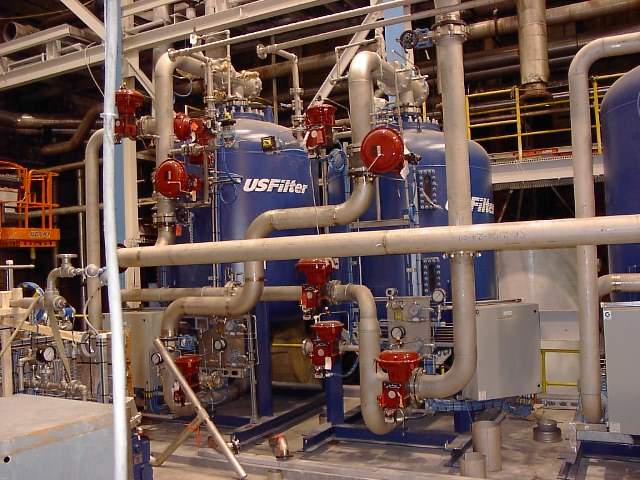
| Pipes can be manufactured from steel, aluminum,
cupper,plastic and concrete. Steel Pipe
Steel pipe is manufactured by several processes. Seamless
pipe, made by piercing or extruding, has no longitudinal
seam. Other manufacturing methods roll a strip or sheet
of steel (skelp) into a cylinder and weld a longitudinal
seam. A continuous-weld (CW) furnace butt-welding process
forces and joins the edges together at high temperature.
An electric current welds the seam in electric resistance
welded (ERW) pipe. ASTM Standards A106 and A53 specify steel
pipe. Both standards specify A and B grades. The A grade
has a lower tensile strength and is not widely used.
The ASME pressure piping codes require that a longitudinal
joint efficiency factor E (Table 1) be applied to each type
of seam when calculating the allowable stress. ASME Standard
B36.10M specifies the dimensional standard for steel pipe.
Through 12 in. diameter, nominal pipe sizes (NPS) are used,
which do not match the internal or external diameters. For
pipe 14 in. and larger, the size corresponds to the outside
diameter.
Steel pipe is manufactured with wall thicknesses identified
by schedule or weight class. Although schedule numbers and
weight class designations are related, they are not constant
for all pipe sizes. Standard weight (STD) and Schedule 40
pipe have the same wall
Copper Tube
Because of their inherent resistance to corrosion and ease
of installation, copper and copper alloys are often used
in heating, air conditioning, refrigeration, and water supply
installations. There are two principal classes of copper
tube. ASTM Standard B88 includes Types K, L, M, and DWV
for water and drain service. ASTM Standard B280 specifies
air-conditioning and refrigeration (ACR) tube for refrigeration
service.
Types K, L, M, and DWV designate descending wall thicknesses
for copper tube. All types have the same outside diameter
for corresponding sizes. Table 3 lists properties of ASTM
B88 copper tube. In the plumbing industry, tube of nominal
size approximates the
inside diameter. The heating and refrigeration trades specify
copper tube by the outside diameter (OD). ACR tubing has
a different set of wall thicknesses. Types K, L, and M tube
may be hard drawn or annealed (soft) temper.
Copper tubing is joined with soldered or brazed, wrought
or cast copper capillary socket-end fittings. Table 4 lists
pressure-temperature ratings of soldered and brazed joints.
Small copper tube is also joined by flare or compression
fittings.
Hard-drawn tubing has a higher allowable stress than annealed
tubing, but if hard tubing is joined by soldering or brazing,
the annealed allowable stress should be used.
Brass pipe and copper pipe are also made in steel pipe
thicknesses for threading. High cost has eliminated these
materials from the market, except for special applications.
The heating and air-conditioning industry generally uses
Types L and M tubing, which have higher internal working
pressure ratings than the solder joints used at fittings.
Type K may be used with brazed joints for higher pressure-temperature
requirements .
Ductile Iron and Cast Iron
Cast-iron soil pipe comes in XH or service weight. It is
not used under pressure because the pipe is not suitable
and the joints are not restrained. Cast-iron pipe and fittings
typically have bell and spigot ends for lead and oakum joints
or elastomer push-on joints. Cast iron pipe and fittings
are also furnished with no-hub ends for joining with no-hub
clamps. Local plumbing codes specify permitted materials
and joints.
Ductile iron has now replaced cast iron for pressure pipe.
Ductile iron is stronger, less brittle, and similar to cast
iron in corrosion resistance. It is commonly used for buried
pressure water mains or in other locations where internal
or external corrosion is a problem. Joints are made with
flanged fittings, mechanical joint (MJ) fittings, or elastomer
gaskets for bell and spigot ends. Bell and spigot and MJ
joints are not self-restrained. Restrained MJ systems are
available. Ductile-iron pipe is made in seven thickness
classes for different service conditions. AWWA Standard
C150/A2l.50, Thickness Design of Ductile-Iron Pipe, covers
the proper selection of pipe classes. |