| HOW
CAN YOU SAVE ENERGY
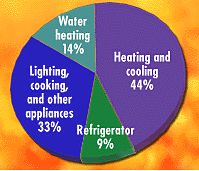
You probably spend many energy dollars on heating and cooling
your building. Employee comfort is a high priority, and
product quality may dictate certain temperature requirements.
Installing the programmable thermostats and energy-efficient
boilers and water heaters described in this section is an
easy way to start saving energy; proper maintenance is equally
important.
You may also be able to save energy by managing the sunlight
that falls on your building. Solar hot water systems and
solar heating systems are two potentially economical solar
energy technologies you might want to consider.
Businesses have found that the following basic steps can
save energy, increase comfort, and enhance equipment operation.
Programmable thermostats
These simple microprocessor-based products offer as much
as a 50% rate of return on energy dollars. In addition,
these devices will maintain system start-up and set-back
schedules for optimum comfort. They can also eliminate unnecessary
HVAC use during unoccupied hours.
Furnace maintenance and cleaning
In easy first step is to replace dirty air filters. It's
often well worth the expense to have a trained specialist
inspect and perform needed maintenance on your furnace and
cooling system. Also, simple maintenance such as cleaning
intake screens, condenser coils, supply registers, and return
grills can make a difference in your energy bills.
Duct maintenance and repair
Typical duct systems lose energy from your heating and air-conditioning
equipment. Use duct tape to seal duct joints and elbows
where accessible. Insulate any duct work in unconditioned
space, such as roofs, attics, crawl spaces, and basements.
Identify and repair damaged or disconnected ducts while
you check the system.
Boilers
If your building uses a boiler for heating, follow the factory
maintenance schedule and procedures. If you're using a fuel
other than natural gas, consider switching to natural gas,
which is less expensive. If maintenance costs for your existing
boiler have become excessive or you need to replace your
boiler, replace it with a high-efficiency model.
Ventilation rate
Building ventilation is necessary so that your building
has a reasonable supply of fresh air. However, excessive
ventilation rates increase your heating and cooling costs
dramatically. Have a professional engineer or trained specialist
optimize your system's ventilation rate.
Hot water supply
Your hot water temperature is often set higher than you
really need. Gradually set the temperature downward until
you reach an optimum. You can also install flow restrictors
and self-closing faucets; they'll reduce your hot water
use. Finally, check your entire system for leaks and repair
them.
Water heater
One of the most effective measures you can use is an insulating
jacket for the water heater. These jackets are easily found
at large convenience, building, and hardware supply stores.
A simple electronic time-of-use controller will ensure that
your electric water heater is off when not needed.
You can use the sun's energy to maximize natural lighting
and heating, which will decrease costs for artificial lighting
and space heating.
On the other hand, you may live in a very warm, sunny
climate where air-conditioning is your building's greatest
energy expense. In that case, you'll want to minimize the
effects of the sun's energy.
Direct sunlight: enhancement or
control
Sunlight striking your building can work for you or against
you. When you're trying to cool your building, you don't
want sunlight pouring in through windows, doors, and skylights,
adding considerably to your air-conditioning bills. However,
when you're heating your building, you want the sunlight
to enter your building.
During the air-conditioning season, provide shading to
windows, doors, and skylights. This can be done effectively
with awnings, sunscreens, shade trees, and shrubbery.
During the heating season, you can save money by permitting
sunlight to enter the building through windows and other
openings. In addition, you'll attain the benefits of daylighting.
Solar hot water systems
Many small businesses (for example, restaurants, bars, and
dry cleaners) have large water-heating needs that can be
economically and reliably met by solar energy. Depending
on the cost of your current water-heating system and its
energy source (oil, electricity, natural gas, or propane),
basic solar water heating or preheating may make economic
sense. Check with local or state energy offices, local utilities,
energy businesses, universities, or your accountant for
the availability of state tax incentives or technical assistance
to businesses using solar water heating systems.
Solar heating systems as supplements
to HVAC systems
Most commercial/industrial warehouses in cold-weather states
are heavy users of thermal energy—heat. In most areas,
an all-electric heating system (the most easily installed)
will be expensive to operate and will leave you vulnerable
to power outages and ever-increasing energy rates.
Supplemental space heating is efficiently provided by
the transpired solar collector, a type of solar collector
that heats air for the building. In 1994, this new collector
received a "Best of What's New" award from Popular Science
(February 1994, page 20). This system has been effectively
demonstrated, meeting winter head-on in Canada. Check with
local or state energy offices, local utilities, energy businesses,
universities, or your accountant for the availability of
state tax incentives or technical assistance to businesses
using solar heating systems.
When You
Go Out |