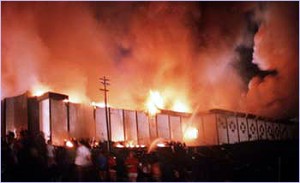
| Anybody who visits a public building with not a thought to fire safety
owes that confidence to the 165 people who died in the Beverly Hills supper
club fire.
What many of us take for granted - sprinklers, well-lit exits, well-designed
hallways - came the hard way, motivated by the indelible images of rolling
black smoke and bodies stacked floor to ceiling in narrow exits.
''Never again'' was almost a mantra after the nationally acclaimed nightclub
burned atop a hill in Southgate on May 28, 1977 - 25 years ago this coming
Tuesday. The horrifying images - spread across the nation via live television
and newspaper photographs - led to a revolution in how to prevent fires
and protect people once they occurred.
Tougher fire codes. Strict inspections. More flame-retardant products.
Required smoke detectors. More sprinklers. More and better marked exits.
Improved electrical wiring. Threats of lawsuits.
''While the loss of life was tragic, it was not in vain,'' said Jeff
Johnson, a fire chief in Oregon who has studied the Beverly Hills fire
like a textbook.
Ken Meredith, deputy com missioner of the Kentucky Department of Housing,
Buildings & Construction, is more blunt: ''The Beverly Hills fire
has saved thousands and thousands of lives.''
But immediately after the blaze, it was impossible to view it as anything
but horrid.
In a span of minutes, a warm, gorgeous Saturday on a Memorial Day weekend
turned tragic at the ''Showplace of the Nation.'' The club was jammed
with an estimated 2,600 people in a partying mood. Many were there to
enjoy singer John Davidson, while others were attending private dinners.
About 9 p.m., a fire that had been smoldering in the ceiling of the club's
unoccupied Zebra Room roared with astonishing speed down a hallway and
into the huge Cabaret Room, where a couple of comedians were warming up
the crowd before Davidson's appearance.
Black smoke and toxic fumes pushed by the roaring flames filled the club,
killing 165 people. All but two of the victims died in massive piles near
two exits leading from the cavernous Cabaret Room, less than 30 feet from
safety.
The circumstances that created the nightmare - including lax inspections,
bad wiring and flammable furnishings - have become watchwords in the fire
prevention industry.
Now, experts say, the 25th anniversary of the fire can be commemorated
by a legacy of life - an unknown number of people who are alive today
because of lessons learned from Beverly Hills.
Those lessons have been studied across the country for the past quarter-century.
''The Beverly Hills fire is one of those handful of fires nationwide
that are used to teach fire students, chiefs and marshals some critical
lessons about fire behavior and crowd behavior,'' said Johnson, fire chief
of the Tualatin Valley Fire and Rescue near Portland, Ore.
''The first lesson is the inevitability of tragedy and large numbers
of deaths if you don't have built-in fire protection like smoke control
systems, sprinklers and exits.
''Inadequate exits was a huge factor in the loss of life at Beverly Hills.
There were stacks of victims in front of exits. Once the fire started,
there wasn't adequate warning. Fire and smoke grew and blocked people's
exits.''
Employees tried but failed to extinguish the fire before many people
were told of the fire.
''Another shortcoming at Beverly Hills was inadequate inspections,''
Johnson said. ''Had proper procedures been followed, the fire might not
have ever started.''
Not much of what Johnson says is new - the fire was studied and restudied
by investigators, juries and others. But its lessons are important to
recall, if for no other reason, to avoid complacency when it comes to
fire protection, he said.
''If we don't apply the lessons we've learned and if we don't hold people
accountable when fire prevention systems are ignored or circumvented,
then we haven't come very far,'' Johnson cautioned.
Attorneys like Stan Chesley of Cincinnati stand ready to enforce that
notion.
''Beverly Hills has led to a safer society,'' said Chesley, who pioneered
the use of class-action, mass tort lawsuits in the wake of the fire.
Chesley, who sued dozens of manufacturers of products that burned in
the Beverly Hills fire, says the blaze led to ''a whole new understanding
of what spreads fires.''
''We now have more flame retardant material,'' he pointed out. ''Foam
rubber has virtually disappeared. Major changes have been made in carpets
and drapes to make them less flammable. Old-style aluminum wiring is gone.
''More importantly, sprinklers have become widespread over the past 25
years. Beverly Hills had no sprinklers. Sprinklers are now everywhere
and nobody thinks about it.''
Because of Chesley, Beverly Hills also set a legal precedent.
''It was the first class-action lawsuit in a mass tort,'' Chesley said
of the legal work that resulted in settlements of $50 million for relatives
of victims. ''We've done the same thing in a lot of cases since then.''
Chesley recalled how he was ''criticized like I was some kind of ghoul''
for digging through Beverly Hills debris searching for evidence.
''The state of Kentucky wouldn't let me investigate, and I had to get
a federal judge to let me do it,'' he said. ''That's how we found the
aluminum wiring and other evidence.''
Southgate Fire Chief John Beatsch, who fought the Beverly Hills fire
as a 21-year-old fire lieutenant, said the 165 deaths changed how firefighters
are trained - and the strategy at fire scenes.
''Prior to Beverly Hills, when you planned for a fire in a big building,
you thought about how to attack the fire,'' he said. ''You assumed everybody
in the building would know about the fire right away and be out.
''Before Beverly Hills, there was not a whole lot of disaster planning
for rescuing people. Since Beverly Hills, there's been a big emphasis
on rescuing people.''
Beatsch recalled that when firefighters arrived at Beverly Hills, they
were surprised that hundreds of people were still in the burning building.
''We were overwhelmed with the number of people who needed help,'' he
said. ''We had never planned for that.''
Beatsch also said that fire prevention inspection shortcomings at Beverly
Hills taught local fire departments not to take anything for granted.
''Being a 'Podunk' fire department, we assumed that if the state approved
something, there would be no problems with it,'' he said. ''Inspections
have improved dramatically since Beverly Hills.''
Julian Carroll, governor of Kentucky at the time of the fire, shook up
the state's fire inspection bureaucracy in the wake of the tragedy.
He created the Kentucky Department of Housing, Buildings & Construction,
with the state fire marshal's office a part of the department.
Fire prevention and building remodeling inspections at Beverly Hills
had been lax.
''There was strong indication of some political shenanigans going on
that may well have contributed to the catastrophe,'' recalled Carroll,
now 71 and a Frankfort attorney. ''We needed to get away from political
favoritism.
''For the past 25 years, we've had a very professionally run Department
of Housing. The department has really concentrated on keeping our codes
up to national standards and making certain those codes are enforced.''
Meredith, deputy commissioner of the department, said Beverly Hills was
''a benchmark, a reference point'' for improved fire protection.
''One of the greatest things that has happened because of better inspections
is an increased public awareness of fire prevention,'' he said. ''Smoke
detectors, for instance, have become a normal part of our lives.''
Despite all the improvements prompted by the fire, Ken Paul, who was
the 30-year-old mayor of Southgate at the time of the blaze, said one
problem still concerns him - controlling crowd size.
''I think building capacity and crowd control will always be a problem,''
said Paul, who later became Campbell County judge-executive. ''You didn't
see capacity signs at the time of the Beverly Hills fire, and you see
them today.
''But how many of us are guilty of thinking, 'Well, we can squeeze a
couple of more people in.'
''Alarms and sprinklers are important, but to me, capacity and crowd
control are keys to safety that will always be a struggle to achieve.''
Wayne Dammert, the banquet captain at Beverly Hills 25 years ago, estimates
there were 2,600 people in the club the night of the fire, about twice
as many as what the popular night spot could safely accommodate.
''At the time, nobody ever said, 'Hey, this is not right. This is overcrowded,'
'' Dammert said. ''Everybody just went on having a good time at Beverly
Hills.''
There were no more good times at Beverly Hills after May 28, 1977; the
club died along with the 165 victims.
The lessons the fire taught came in the wake of a death toll that still
is difficult to comprehend.
''Yes, a lot of lessons have been learned from Beverly Hills,'' acknowledged
Beatsch, the Southgate fire chief. ''Unfortunately, it was a very tragic
event we went through to learn the lessons
Back to Hotel Fires
|