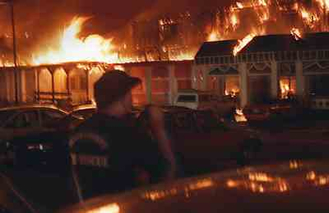
Employees wake up guests after
automatic alarms fail to sound
Fire sprinklers and alarms at the Gold Strike
hotel near Boulder City did not go off immediately during
a blaze that destroyed the casino early Tuesday.
And, fire inspectors said portions of the casino that fueled
the four-alarm fire were inspected under safety codes dating
to 1977, which were less stringent than today's state and
county requirements.
Hotel employees who helped evacuate hundreds of guests had
to go door to door to warn people of the fire. Guests staying
in the hotel's 17-story tower then navigated their way through
smoky hallways and descended several flights of stairs to
safety.
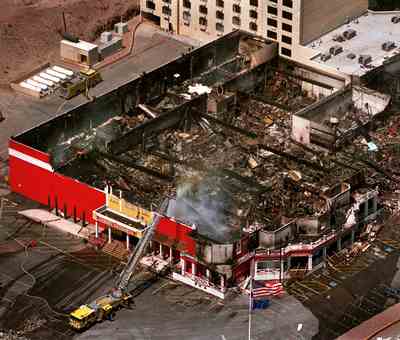
An aerial photo of the Gold Strike shows the magnitude of
devastation resulting from a four-alarm fire that raced
through the property Tuesday morning, gutting the casino.
No injuries were reported.
There were no injuries. Damage was estimated
at $20 million to $30 million.
"Why didn't
the alarms go off?" said guest Charlene Smith of
the Flathead Indian Reservation in Arizona, who was
sleeping in her room on the ninth floor when the fire
started. "There was definitely enough smoke to
set them off. If a person was a sound sleeper, who knows
if they would have known what was going on."
Clark County Fire Department spokesman Steve La-Sky
said employees of the hotel-casino on U.S. Highway 93,
just outside of Boulder City and near Hoover Dam, reported
the blaze to authorities at 1 a.m. It appears the fire
started on the outside of the casino facing the highway,
possibly in construction materials. The flames quickly
climbed a wooden wall of the casino's facade and into
the roof of the gambling hall, leaping over the casino's
fire detection systems
Boulder City firefighters were the first to arrive at
the scene and quickly called for assistance from firefighters
from Henderson, the National Park Service and Clark
County.
"By the time we got there the fire was going pretty
good on the facade and also burning strongly on the
roof," Boulder City Fire Department Chief Dean
Molburg said. Firefighters sprayed the blaze with single
lines supplied with water by a 6-inch pipeline leading
from Boulder City. |
|
|
The water from that pipe alone, which transfers about 1,400
gallons of water a minute, was not enough to fight the blaze,
Molburg said.
"If it was in the city of Las Vegas or even Boulder
City, we would have more than one water source," Molburg
said. "But with only one water source, there are limitations."
Firefighters also accessed a 1 million gallon water reserve
stored in tanks at the Gold Strike. But when the roof of
the casino collapsed, the hotel's sprinkler system ruptured.
That rupture caused thousands of gallons of water to drench
the burning casino at once, draining the hotel's water supply.
"Once that roof came in, it (the water) was basically
being wasted," Molburg said.
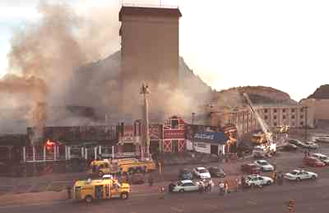
When county firefighters arrived, there was little that
could be done to put out the fire, La-Sky said. The 100
or so firefighters on the scene were forced to contain the
blaze by spraying the exterior of the hotel's tower and
also an adjoining three-story section of rooms.
"When we got here the fire was already fully involved
and we had to go into a purely defensive mode," La-Sky
said. "It was basically a case of surround and drown
the building."
La-Sky said the problems with water pressure and access
delayed extinguishing the hot spots for several hours. Firefighters
used about 1.5 million gallons of water to fight the flames,
and the fire was controlled by 4:30 a.m.
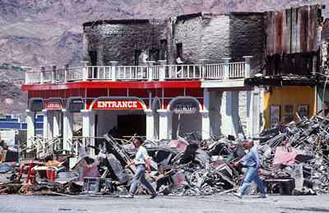
The casino was destroyed. La-Sky said at least eight rooms
in the three-story extension were damaged by smoke, fire
and water. The hotel tower was relatively undamaged.
Authorities have not determined a cause of the blaze.
"It could have been a cigarette butt tossed into debris,
or it's feasible it could have been intentionally set,"
La-Sky said. "Unless the investigators find something
really unusual, there may be no real way of telling."
Gold Strike executives have scheduled a Friday job fair
for the property's 400 employees, with representatives of
Circus Circus Enterprises Inc. attempting to find jobs for
the displaced workers at Circus Circus properties. The Gold
Strike is owned by three men who are principal owners of
Circus Circus.
"How do we help these 400 employees who have been so
loyal?" said Dave Belding, a Gold Strike co-owner and
Circus Circus executive. "That became our primary concern
after we knew there were no injuries."
La-Sky could not provide the number of guests evacuated
but estimated it was in the hundreds. Most guests were relocated
at the Monte Carlo under the guidance of the American Red
Cross.
"There wasn't much time to grab anything," said
Yuma, Ariz., resident Jerry Taylor, a Bureau of Reclamation
employee staying at the hotel overnight. "I grabbed
my briefcase and my laptop and got out of there."
 |
Kenneth Clopton of Houston and his wife, Patsy, walked
from their room down several flights of stairs to safety
after a hotel employee knocked on their door at 1:20
a.m. Kenneth Clopton questioned why no alarms sounded
as they left the building.
"The alarms should
have gone off," he said. "Every time I went
to a different floor, I didn't know what to expect."
Bruce Way and his wife, Beatrice, of Fort Myers Beach,
Fla., said because they heard no alarms, they didn't
take seriously the initial warnings of hotel staffers.
"There was a man knocking on the doors and
he didn't speak very good English -- we really didn't
understand him," Bruce Way said. "At first
we didn't think anything of it. We just thought it was
some drunk."
The hotel's alarm system was eventually manually pulled
by an employee, Molburg said. The time that elapsed
between the evacuation of the rooms and when that system
was deployed was not immediately known. |
 |
| |
Clark County has some of the most stringent fire and building
codes in the nation. The codes have evolved primarily because
of past tragedies, including the MGM Grand fire in 1980
that killed 87 and injured 650. Three months later a fire
at the Las Vegas Hilton killed eight, prompting changes
in building and fire codes.
The Gold Strike is inspected quarterly by two private businesses
hired by the hotel under state guidelines: The company that
inspects the sprinkler system is Las Vegas-based Tri-State
Fire Protection; Statewide Automatic Fire Electronics inspects
the alarms.
A spokeswoman for SAFE declined comment. Larry Campbell,
president of Tri-State, said the Gold Strike was always
diligent in meeting fire and building codes.
"Their maintenance crew is so tuned in to fire protection
because they knew the vulnerability they had with lack of
response time and very limited limited resources,"
Campbell said.
Campbell said it appears the wood portions of the Gold Strike's
roof, along with extensions from the hotel's facade, fueled
the fire early on. Portions of the current fire and building
codes address the deployment of sprinkler systems in such
areas and also require that methods be used to reduce combustibility.
However, part of the Gold Strike's roof was inspected based
on fire codes dating to 1977 -- and not the most recent
code, Campbell said. Under state guidelines, the Gold Strike
would have had to take certain precautions such as covering
exposed wood beams and installing Sheetrock only if it were
to begin a significant remodeling or addition. The latest
addition to the hotel was in 1995, before some of the codes
were modified, Campbell said.
"They (the new fire and building code provisions) were
grandfathered in," Campbell said.
"In my opinion, with the nature of the fire being on
the facade and roof structure, it could bypass the sprinkler
system and overwhelm it," Campbell said. "With
the new building codes, they've increased some of the requirements
and are a lot more stringent. They (install) Sheetrock,
cover exposed beams. In this case all this exposed wood
fueled the fire."
Campbell said the Gold Strike already had placed sprinklers
in several canopies of the casino, but some small wooden
protrusions at the roof "would have fallen into a different
category" of regulations.
In addition to the private inspections, the county Fire
Department conducts regular inspections of all resorts,
Deputy Fire Marshal John Hall said. The last county inspection
of the Gold Strike was conducted in 1997.
"Just on a cursory review of our records, I don't see
any problems out there," Hall said.
Molburg said a variety of safety issues, including why the
alarm and sprinkler systems did not immediately go off,
will likely be addressed in the fire investigation.
"We will have all those answers," Molburg said.
"We just don't have them right now."
|